18+ only. Gamble responsibly. Call or text 1-800-MY-RESET.Independent reviews. We may earn a commission when you sign up, which never changes our rankings.

 6 June 2025
 5 minutes to read


Cajun Stud is a deceptively simple poker variant that shares its DNA with Mississippi Stud. There is no dealer hand to beat. It is only you, your two hole cards, three community cards, and a paytable. The goal is straightforward: build a five-card hand of Jacks or Better.
However, the strategy lies in the betting structure. Unlike standard table games where you place one bet and wait, Cajun Stud forces you to make three separate financial decisions during the hand. You can raise 1x, 2x, or 3x your Ante, or fold. Make the right choice, and you can win massive multiples. Make the wrong choice, and you will drain your bankroll in minutes.
In this comprehensive guide, I will break down the optimal strategy for every street, analyze the unique “Lo-Ball” side bet, and explain why “Max Raising” is the only way to lower the house edge.
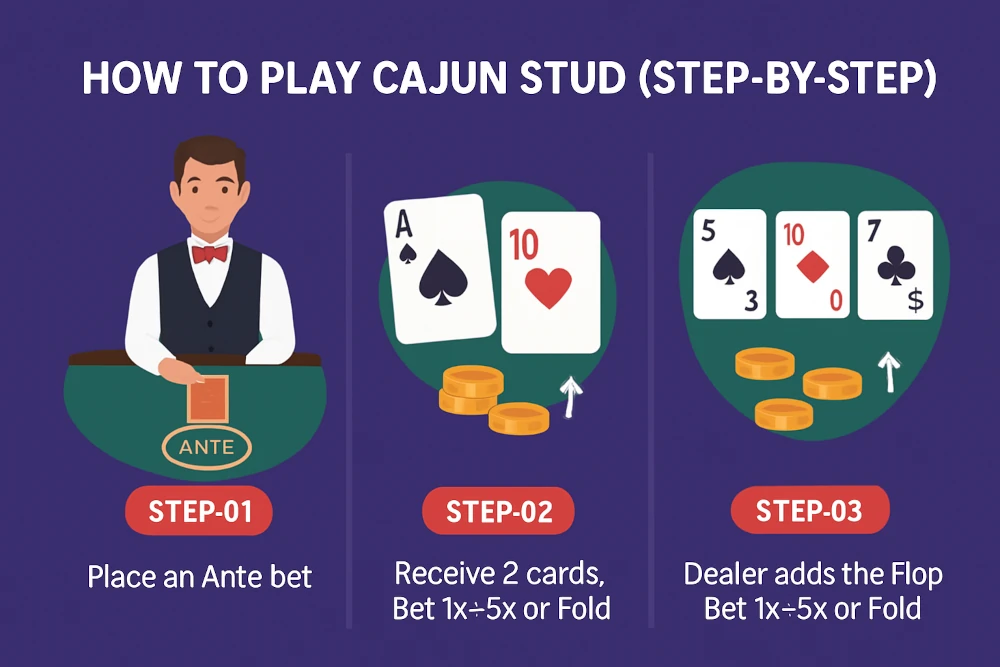
The layout features three community cards and multiple betting circles.
Cajun Stud is played with a single 52-card deck. The game flow is distinct because you are buying “information” with every bet.
Step 1: The Ante & Deal
You place a wager in the “Ante” circle. You receive two cards face down. The dealer places three community cards face down on the layout.
Step 2: 3rd Street (First Decision)
Looking at your two hole cards, you must decide:
The dealer then reveals the first community card.
Step 3: 4th Street (Second Decision)
Based on your 3 visible cards (2 hole + 1 community), you must again Bet 1x-3x or Fold.
The dealer reveals the second community card.
Step 4: 5th Street (Final Decision)
Based on your 4 visible cards, make your final 1x-3x Bet or Fold decision.
The dealer reveals the final card. Payouts are made on the 5-card poker hand.
Unlike Blackjack, you aren’t trying to beat a dealer score. You are simply trying to qualify for the paytable. The payouts apply to your Ante and ALL of your Raise bets.
| Hand Ranking | Payout Odds |
|---|---|
| Royal Flush | 500 to 1 |
| Straight Flush | 100 to 1 |
| Four of a Kind | 40 to 1 |
| Full House | 10 to 1 |
| Flush | 6 to 1 |
| Straight | 4 to 1 |
| Three of a Kind | 3 to 1 |
| Two Pair | 2 to 1 |
| Pair of Jacks or Better | 1 to 1 (Even Money) |
| Pair of 6s through 10s | Push (Bet Returned) |
| Pair of 5s or Less | Loss |
Key Insight: The “Push” on 6s through 10s is critical. It saves your bankroll during cold streaks. You don’t win, but you live to play another hand.

To minimize the house edge, you must play mathematically perfect poker. The core principle is aggression: If you have a hand, raise 3x. If you are chasing, raise 1x. If you have junk, Fold. Never raise 2x (it is mathematically inefficient).
Cajun Stud offers several optional side bets. The most unique is the Lo-Ball, which pays out for bad hands.
The Lo-Ball Bet:
This bet pays if your final 5-card hand is 7-High or less (No pairs, no flush, no straight). Basically, if you have absolute garbage, you win.
Warning: The House Edge on Lo-Ball is typically around 7-9%, making it a “sucker bet” compared to the main game. Play it for fun, not profit.
Cajun Stud has high variance. Because you can bet up to 10 units (1 Ante + 3x + 3x + 3x) on a single hand, your chip stack can fluctuate wildly. When you catch a good hand, you win big. When you get cold cards, the Ante and 1x raises chip away at you.
To play comfortably, bring enough for 50 hands at your max potential risk.
Cajun Stud is a proprietary game developed by Galaxy Gaming. For the exact mathematical proofs of the strategy charts, I recommend the analysis by The Wizard of Odds, which confirms the 4.91% element of risk.
Cajun Stud rewards the brave. The mathematics of the game dictate that you must press your advantage when you have a Pair of 6s or better. If you play timidly and only raise 1x on winning hands, the house edge will eat you alive. Raise 3x, dodge the 5s, and hope for that Royal Flush. Good luck.
🧠 Want to explore more high-payout games? Check out these guides:
Mark Taylor Analysis • Updated: January 26, 2026 Three Card Poker is the most successful proprietary casino table game of all time. Invented by Derek Webb in 1994, it was design...

Mark Taylor Slot Analysis • Updated: February 6, 2026 Penny slots aren’t just for “broke” players. They are the secret weapon of smart bankroll management. I have pl...

Mark Taylor Chief Auditor • Updated: January 17, 2026 It is a suspicion every roulette player has felt. You are winning consistently with a Martingale strategy, and then—suddenl...

The 2026 Mathematical Breakdown Slot Mathematics by Mark Taylor Updated: March 12, 2026 Every single mobile slot in the app store or offshore casino lobby promises incredible ex...