-
Casinos
Online Casinos
Casino Software:
- Crypto
-
Casino Games
Casino Games:
- Real Money Slots
- Bonuses
- Banking
- Guide
 1 June 2025
 6 minutes to read


You don’t play Mississippi Stud against the dealer; you play against yourself, your discipline, and the cold hard math of probability. Created by Mark Yoseloff of Shuffle Master (now Light & Wonder), this game is unique because it forces you to buy your way to the river.
Unlike Blackjack where the decision tree is binary (Hit or Stand), Mississippi Stud requires you to make three separate betting decisions in a single hand. You are building a five-card hand hoping for a Pair of 6s or better. The trap? You have to pay to see every card. If you play on “gut feeling,” the house edge balloons to over 5%. But if you play optimally—using the “Barbell Strategy” of betting 1x or 3x—you can slash the Element of Risk to just 1.37%.
🛡️Editorial Transparency: We independently audit all casinos. We may earn a commission if you visit them through our links. Read our Editorial Policy.
In this master guide, I will break down the mathematics of every street, introduce the “Point System” for hand valuation, and show you exactly how to crush the game in 2026.
If you only read one section, read this. The secret to winning isn’t bluffing; it’s Bet Sizing Efficiency.
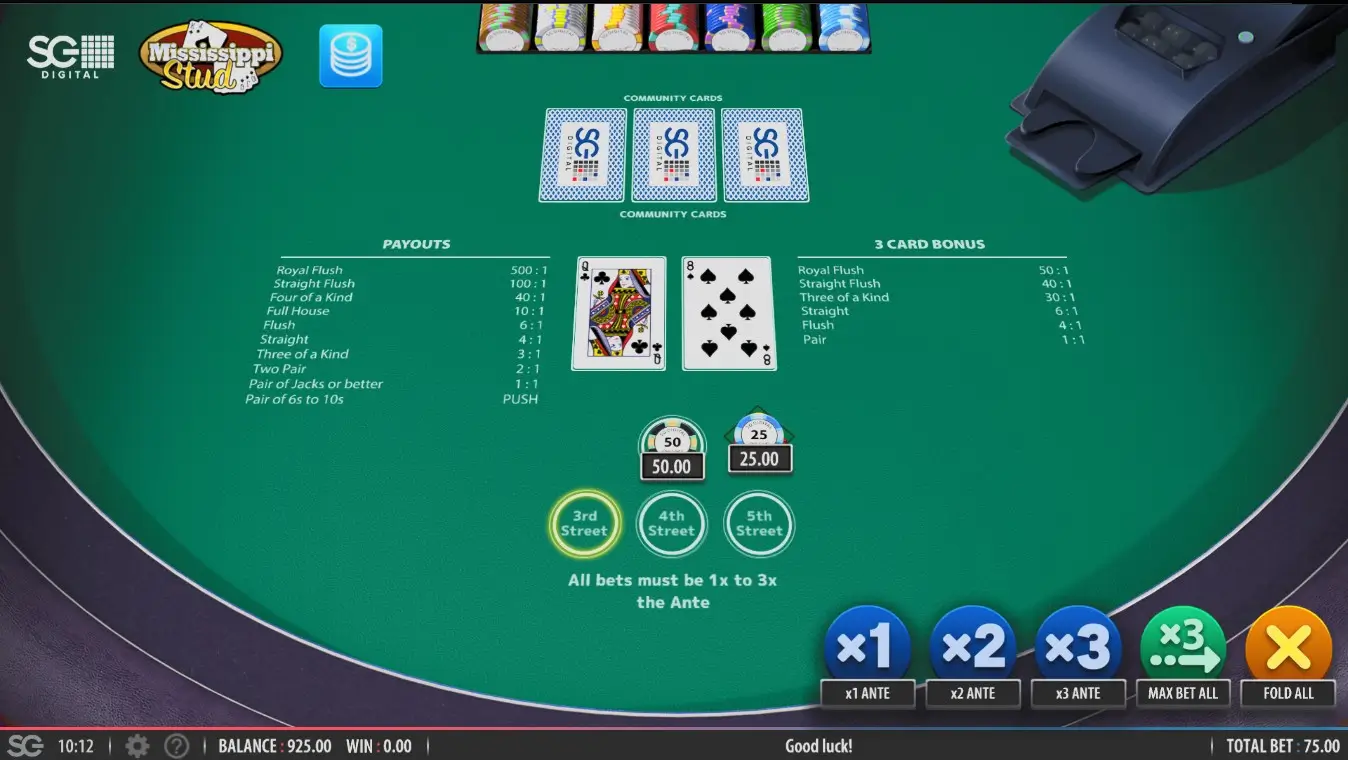
Mississippi Stud is a 5-card poker variant played with a standard 52-card deck. It is found at most top online casinos. The table layout features one circle for your Ante and three circles for the “Streets” (3rd, 4th, and 5th Street).
Step 1: The AnteYou place an opening bet (e.g., $5). You receive two hole cards face down. The dealer places three community cards face down in the center.
Step 2: The StreetsTo see each community card, you must bet. You have three choices: Fold, 1x Ante, or 3x Ante. This happens three times.
Why “Stud”?
In traditional 7-Card Stud, some cards are face up and some are face down. In Mississippi Stud, you combine your hidden cards with shared cards, but unlike Texas Hold’em, there is no “Dealer Hand” to beat. You are strictly playing against a paytable.
Understanding the paytable is more important than understanding the cards. Why? Because the payout structure dictates your aggression level. The table below outlines the standard returns found at sites like Bovada.
| Hand | Payout (Per Bet) | Probability |
|---|---|---|
| Royal Flush | 500 to 1 | 0.00015% |
| Straight Flush | 100 to 1 | 0.00135% |
| Four of a Kind | 40 to 1 | 0.024% |
| Full House | 10 to 1 | 0.144% |
| Flush | 6 to 1 | 0.197% |
| Straight | 4 to 1 | 0.39% |
| Three of a Kind | 3 to 1 | 2.11% |
| Two Pair | 2 to 1 | 4.75% |
| Pair of Jacks+ | 1 to 1 | 21.4% |
| Pair of 6s to 10s | Push (0 to 1) | Depends |
Memorizing charts is hard. Using the “Point System” is easy. This system assigns a value to every card in your hand to determine if it is playable. This is the exact method pro grinders use.
Card Values:
Look at your two hole cards and add up their points.
Raise 3x If:
You have Any Pair.
(Even a pair of 2s is worth a 3x bet because you are guaranteed not to miss the board entirely).
Raise 1x If:
Your hand has 2 Points or more.
Examples: J-6 (2+1=3 pts), Q-K (2+2=4 pts).
Exception: 5-6 Suited is also a 1x Raise.
Fold If:
You have less than 2 points. Example: 4-9 (0+1=1 pt). FOLD. Do not chase.
The first community card is out. You now have 3 cards. The strategy shifts from “Points” to “Made Hands vs. Draws.”
| Action | Condition |
|---|---|
| Raise 3x | • Any Pair of 6s or Better • Royal Flush Draw (Suited Q, K, A) • Straight Flush Draw (Suited 7, 8, 9 with no gaps) |
| Raise 1x | • Any Low Pair (2s-5s) • Flush Draw (3 suited cards) • Open-Ended Straight Draw (e.g., 6-7-8) • 3 Points or more (e.g., K, Q, 4) |
| Fold | Everything else. If you have nothing paired and no draw, fold. Do not pay for the next card. |
This is the “River” decision. You have 4 cards visible. You are paying to see the final card.
The Rule of Thumb: If you are already winning (Pair of 6s+), bet max. If you are drawing, you need a high probability draw (Flush or Open-Ended Straight). Gutshots (Inside Straights) are usually folds unless you have High Cards to fall back on.
Why We Don’t Bet 2x:
You might be tempted to bet 2x on a “Medium” hand. Don’t. The math of Mississippi Stud is polar. Either your Expected Value (EV) is high enough to justify 3x, or it is low enough that 1x (or Fold) minimizes loss. 2x is a “leak” that costs you money over time.
If you look up Mississippi Stud on Wikipedia, you’ll see a House Edge of 4.91%. This scares many players away. It looks worse than Roulette (5.26%). But this number is misleading.
House Edge is calculated based on the initial bet (Ante) only. But in Mississippi Stud, you can bet up to 10 units total (1 Ante + 3x + 3x + 3x). A better metric is the Element of Risk.
With an Element of Risk of 1.37%, Mississippi Stud is actually one of the better table games in the casino, comparable to Craps and Baccarat, provided you have the bankroll to withstand the volatility.
Mississippi Stud has extremely high variance. You will fold a lot. You will lose many 1x bets waiting for that one monster hand. If you play with a “scared bankroll,” you will fail.
| Ante Size | Recommended Session Bankroll (50x) | Risk of Ruin (Low) |
|---|---|---|
| $1 | $50 | High |
| $5 | $250 | Medium |
| $10 | $500 – $700 | Low |
| $25 | $1,500+ | Safe |
Most Mississippi Stud tables offer a “3 Card Bonus” side bet. This bet pays based on the three community cards.
The Warning:
While the main game has an Element of Risk of 1.37%, the 3 Card Bonus typically has a House Edge of 7.0% to 13.0% (depending on the specific paytable). It is a “Sucker Bet.” Avoid it if you want to win long-term.
Finding this game online can be tricky as some software providers rename it. Look for “Ride ‘Em Poker” or similar variations at these trusted sites:
Why: Low minimum bets ($1). Perfect for learning the strategy without risking a huge bankroll. Their software is fast and mobile-friendly.
Why: High limits. If you want to bet $100 per Ante (meaning $1,000 potential total bet), this is the place. Fast crypto withdrawals.
Mississippi Stud is not a game for adrenaline junkies who want action on every hand. It is a game for the grinder. It rewards the player who can fold 20 times in a row, wait for the Pocket Kings, and then fearlessly bet 3x, 3x, 3x to stack chips. There are no bluffs here. Just you, the Point System, and the discipline to execute. Good luck.
A Pair of Aces. Since you are guaranteed a payout (1:1) regardless of the community cards, you should bet 3x on every single street to maximize your win. You cannot lose money on this hand.
Generally, no. The math suggests a “Barbell Strategy”: either you have a significant advantage (Bet 3x) or you are playing defensively (Bet 1x). Betting 2x usually means you are unsure of the math, which is a long-term leak in your game.
This is a “Push.” You don’t win, but you don’t lose. You should bet 3x to start (since you cannot lose) and hope to improve to Three of a Kind.
It depends on your goal. Mississippi Stud has higher variance (bigger wins and bigger losses) because you can bet up to 10 units. UTH has lower variance but a more complex strategy chart.
Yes. Most online casinos like Bovada and Ignition offer a “Practice Mode” where you can test your strategy without risking real money. I highly recommend playing at least 100 hands for free to memorize the 3x/1x/Fold chart.
No. Unlike Caribbean Stud or Three Card Poker, there is no dealer hand to beat. You are paid solely based on the strength of your own 5-card hand according to the fixed paytable.

iGaming Industry Analysis by Mark Taylor Updated: March 16, 2026 Broadcasting real-money casino content underwent a violent paradigm shift over the last three years. The frictio...

Mark Taylor Table Games • Updated: January 22, 2026 Let It Ride Poker is a unique beast in the casino world. It is one of the few games where you are not playing against the dea...