-
Casinos
Online Casinos
Casino Software:
- Crypto
-
Casino Games
Casino Games:
- Real Money Slots
- Bonuses
- Banking
- Guide
 14 November 2025
 6 minutes to read



Broadcasting real-money casino content underwent a violent paradigm shift over the last three years. The friction point for modern creators is no longer hardware capabilities or upload speeds; it is navigating complex international regulations, hostile platform algorithms, and the logistical challenges of scaling an offshore affiliate business without violating Terms of Service.
🛡️Editorial Transparency: We independently audit all casinos. We may earn a commission if you visit them through our links. Read our Editorial Policy.
Following the massive algorithmic purges on legacy platforms, the entire casino streaming demographic successfully migrated to decentralized or crypto-backed broadcast networks. However, surviving in this highly lucrative niche requires significantly more than a webcam and a bankroll. You must understand the legal frameworks of your specific geo-location, deploy strict operational security to prevent IP leaks, and flawlessly execute Federal Trade Commission (FTC) compliance disclosures.
This comprehensive guide is engineered specifically for serious creators who stream real-money slots and high-stakes table games. I will break down the exact encoding architecture required for high-motion HTML5 games, the regulatory realities of broadcasting offshore casinos to a global audience, and why Kick remains the undisputed king of the sector in 2026.
You do not need a multi-million dollar Hollywood studio, but you absolutely cannot broadcast high-volatility, fast-moving slot animations on a subpar rig. Slot machines are technically categorized as “high-motion, high-color-variance” visual assets. If your bitrates are incorrect, the digital confetti and rapidly spinning reels will instantly pixelate your stream into an unwatchable, blurry mess.
Do not use x264 CPU encoding for casino streams; the browser running the HTML5 games will compete for processing power, causing dropped frames. Utilize a modern NVIDIA GPU and run your OBS Studio via the NVENC encoder. To maintain crystal clear 1080p at 60fps during a massive Megaways feature trigger, you must push your Constant Bitrate (CBR) to a minimum of 6,000 to 8,000 kbps.
Stream snipers and malicious actors will actively try to compromise your accounts. You must implement a “Stream Delay” of at least 15 seconds. Never expose your cryptocurrency deposit addresses on screen, and utilize virtual audio cables to separate your Discord/desktop audio from the slot machine’s audio to prevent accidental sensitive data leaks.
Choosing your broadcast platform is a critical business decision. Selecting the wrong network will result in algorithmic suppression, demonetization, or permanent channel deletion.
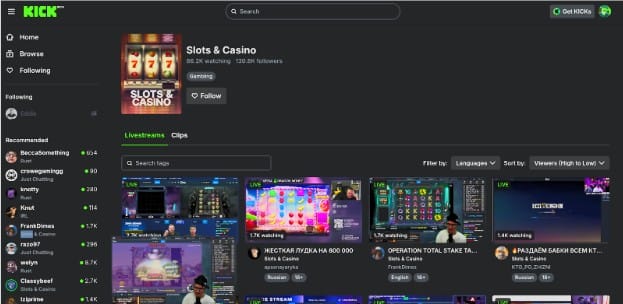
Kick was strategically launched by Ed Craven and Bijan Tehrani, the co-founders of the crypto-casino titan Stake.com. It was explicitly built to absorb the massive, orphaned audience left behind when legacy platforms violently altered their gambling policies (detailed brilliantly in Forbes’ profile on Ed Craven).
In late 2022, Twitch deployed a brutal policy update banning streams of slots, roulette, and dice games operated by unlicensed offshore entities. They specifically targeted offshore crypto giants. If you attempt to stream high-stakes offshore action here, your channel will be swiftly terminated.
YouTube is a terrible platform for live casino streams. Live broadcasts frequently trigger automated community guideline strikes or are instantly age-gated into obscurity. However, YouTube is mandatory for VODs (Video on Demand). Utilize it strictly for highly edited, SEO-optimized highlight reels and massive jackpot clips.
This is not an ideological debate between “regulated” and “offshore.” It is pure business mathematics. Streaming requires highly engaging, volatile, and massive-stakes content. Locally regulated, state-run casinos simply cannot provide the technical infrastructure or the financial freedom that entertainers require.
The act of streaming a video game is universally legal. The legal friction arises from promoting an offshore gambling entity to citizens within a specific restricted jurisdiction. Here is the operational reality.
Real-money online casinos are ring-fenced and strictly regulated in only a handful of states (NJ, PA, MI, CT, DE, WV, RI). Because 85% of the US lacks local options, offshore casinos remain heavily dominant. Streamers broadcasting from the US must prominently display 21+ messaging and rigorously adhere to FTC marketing disclosures (#Ad) to avoid severe federal fines.
The UK Gambling Commission (UKGC) and the Advertising Standards Authority (ASA) are fiercely strict. If you stream from the UK, you cannot utilize marketing language that appeals to minors, and you absolutely cannot frame gambling as a viable solution to financial problems. You must integrate responsible gaming links (like BeGambleAware) permanently on-screen.
Australia’s Interactive Gambling Act (IGA 2001) penalizes the operator, not the player or the affiliate, allowing offshore streams to thrive. In Canada, outside of the strict AGCO regulations in Ontario, the rest of the provinces widely accept and view offshore casino streams without significant governmental interference.
Failing to abide by marketing regulations will get your stream nuked and your affiliate funds confiscated. Run this strict pre-flight checklist before hitting the “Go Live” button.
Casino streaming is an incredibly lucrative entertainment sector, but it is fundamentally a high-risk business. The symbiotic relationship between Kick’s decentralized ethos and the offshore casino market’s massive crypto liquidity has created the perfect environment for creators to thrive in 2026.
However, if you are serious about scaling your channel, you must treat compliance as your highest priority. Understand your local advertising laws, strictly disclose your affiliate partnerships, utilize professional encoding hardware, and treat offshore casinos with the exact same unyielding discipline you expect from your viewers: clear limits, absolutely zero financial fantasies, and total transparency about the mathematical risks of gambling.
No, it is not illegal to stream offshore gameplay on Kick. The platform openly permits the broadcasting of unregulated crypto casinos, provided the streamer utilizes the platform’s age-gating tools and ensures the casino operator enforces adequate age verification on its end.
“Fill” refers to artificial funds directly injected into a streamer’s account by the casino operator for promotional purposes. FTC guidelines strictly mandate that if a creator is gambling with casino-provided “fill” rather than their own raw capital, they must explicitly disclose that it is a sponsored broadcast.
In late 2022, Twitch received immense public backlash regarding gambling addiction among its younger demographic. To mitigate corporate liability, Twitch banned streams featuring slots, roulette, or dice from any operator that is not strictly licensed in the US or other highly regulated jurisdictions.
While not strictly mandatory, a dual-PC setup is highly recommended for professional streamers. Modern HTML5 slots consume massive amounts of RAM and CPU power. Offloading the OBS encoding to a dedicated streaming PC ensures the broadcast remains at a pristine 60fps without lagging the gameplay.
Mark Taylor Poker Strategies • Updated: January 26, 2026 You don’t play Mississippi Stud against the dealer; you play against yourself, your discipline, and the cold hard math o...

Mark Taylor Table Games • Updated: January 22, 2026 Let It Ride Poker is a unique beast in the casino world. It is one of the few games where you are not playing against the dea...