18+ only. Gamble responsibly. Call or text 1-800-MY-RESET.Independent reviews. We may earn a commission when you sign up, which never changes our rankings.
 8 June 2025
 6 minutes to read


When you press “Spin” on a slot machine, you aren’t just engaging with graphics and sound effects; you are engaging with a complex mathematical algorithm. The most important number in that algorithm is RTP (Return to Player). Yet, despite its importance, it is arguably the most misunderstood concept in gambling.
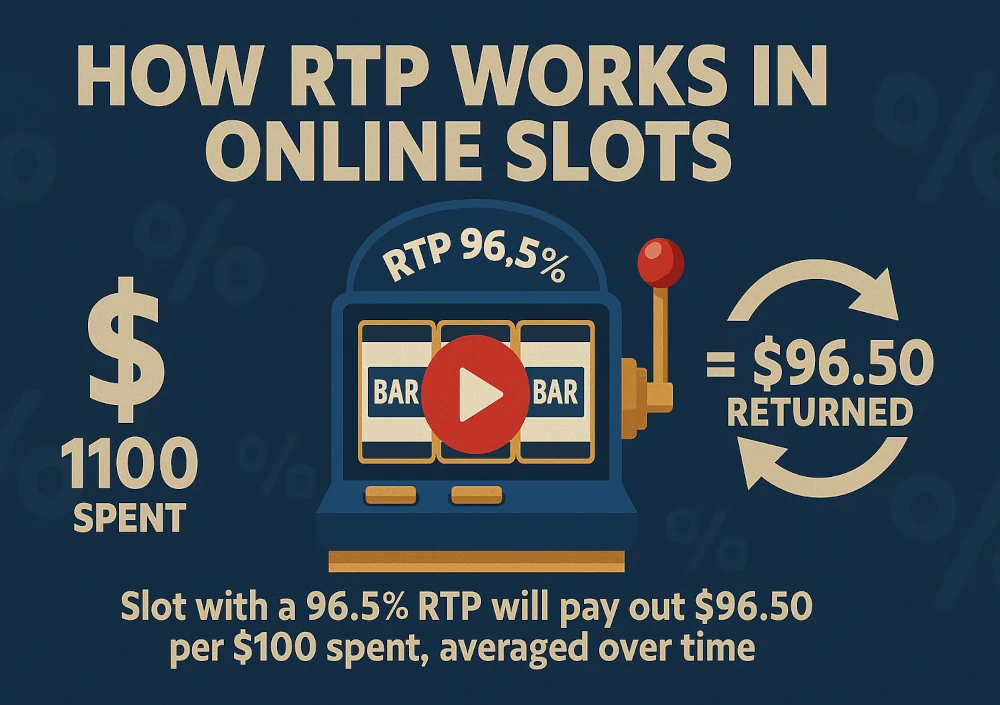
Many players assume a “97% RTP” means they will leave the casino with $97 for every $100 they brought. This is false. RTP is a long-term statistical average calculated over millions of spins. It does not predict your short-term results. To truly understand how real money slots work, you must look at the interplay between RTP, Hit Frequency, and Volatility.
In this comprehensive guide, I will deconstruct the math behind the machine. We will calculate your “Theoretical Loss per Hour,” explain why online slots pay better than Vegas cabinets, and analyze the top-paying games of 2026.
RTP is the percentage of total wagered money that a slot is programmed to pay back to players over time.
You cannot choose a slot based on RTP alone. Two games can both have 96% RTP but play completely differently. This difference is defined by Volatility (or Variance).
Low Volatility
Behavior: Pays out frequently but in small amounts (1x – 5x stake).
Best For: Clearing bonuses, small bankrolls, extending playtime.
Risk: Low. Your balance declines slowly.
High Volatility
Behavior: Pays out rarely, but wins can be massive (1,000x – 50,000x).
Best For: Jackpot hunting, large bankrolls, thrill seekers.
Risk: High. You can endure hundreds of “dead spins.”
Smart players treat gambling as entertainment with a cost per hour, just like seeing a movie. You can calculate your theoretical loss using a simple formula:
Let’s compare a Penny Slot ($0.50/spin) vs. a High Limit Slot ($5.00/spin) assuming 600 spins per hour and a standard 96% RTP (4% House Edge).
The Lesson: RTP remains the same, but your exposure changes with your bet size. To play longer, you must lower your bet or find a higher RTP machine.
Not all slots are created equal. Below is a detailed breakdown of the highest RTP games currently available to US players, tested for volatility and payout behavior.

The Math: With an RTP of 96.33%, this slot is a mathematical outlier. It achieves this high return through “Expanding Wilds” in the base game. Unlike high-volatility slots that hoard RTP for the bonus round, Slam Dunk Spins distributes more payouts in regular play. This results in a smoother equity curve and longer play sessions.

The Strategy: Bounding Luck offers Free Spins, symbol upgrades, and a collector bonus. The RTP is 96.28% with an average free spin trigger of 60 spins. This high hit frequency makes it ideal for clearing wagering requirements, as you are constantly recycling your bankroll.

The High Risk Play: A 25,280x jackpot on a $0.20 bet? Yes, it’s possible. Captain’s Quest is high volatility. You will lose fast, or you will win huge. The RTP is concentrated in the Free Spins multipliers. If you hit the bonus, the returns can be astronomical. If you don’t, the session RTP will feel much lower than 96%.

Progressive Power: Don’t let the Valentine’s Day vibes fool you, Hearts Desire has serious teeth. It connects to a $79,000+ Mega Jackpot network. With 4 progressive jackpots and Free Spins that trigger fast, it’s great for small stakes players chasing a surprise windfall.

The Grid Gem: Wild Drops is Betsoft’s overlooked gem. It features 5-reels and 8-rows with avalanche-style drops. I hit 3 features in under 80 spins and won 35x my stake. The bonus clearing power here is immense due to the constant small wins.
Why do seasoned players prefer online slots? The answer is overhead costs. Land-based casinos have massive expenses (staff, electricity, real estate). They pay for this by lowering slot RTPs.
The Impact: That 5% difference is massive. On $10,000 worth of wagers, the online player retains $500 more than the Vegas player purely due to the math model.
Never trust a casino’s marketing. Verify the math yourself inside the game client.
Misconceptions about slot math cause players to lose money. Let’s correct the record.
Myth 1: “A slot is ‘due’ to pay.”Fact: Each spin is an independent event determined by the RNG. The machine does not have a memory. It does not know if you lost the last 100 spins.
Myth 2: “Casinos change the RTP on weekends.”Fact: Online casinos cannot easily alter RTP. The math file is hosted on the game provider’s server (e.g., Nucleus), not the casino’s server. Changing it requires regulatory approval.
Myth 3: “Max Bet increases RTP.”Fact: In modern video slots, RTP is usually consistent across all bet sizes. However, some games (like Progressive Jackpots) may require a max bet to qualify for the top prize.
RTP is your best friend when claiming a casino bonus. If you have a 30x wagering requirement, you want a slot that recycles your money efficiently without busting.
The Play: Choose a High RTP (96.5%+) + Low Volatility game. This minimizes the house edge while you grind through the wagering volume. Avoid high-variance jackpot slots for bonus clearing, as they drain funds too quickly.
Understanding RTP allows you to treat slots as a strategy game rather than pure gambling. While you cannot beat the house edge forever, playing high-RTP games minimizes your losses and maximizes your playtime. Stop guessing and start checking the numbers. The difference between a 92% slot and a 96% slot is the difference between a 1-hour session and a 4-hour session. Choose wisely.
A “good” RTP is anything above 96.00%. The industry average for online slots hovers around 95-96%. Games with 97% or higher are considered excellent value.
No. RTP is a long-term theoretical average. In a short session, volatility dominates. You can lose your entire bankroll on a 99% RTP game if luck is not on your side.
No. Hit Frequency is how often a spin results in a win (e.g., 20% of spins). RTP is how much money is returned. A slot can have a high hit frequency but low payouts (low volatility), or low hit frequency with huge payouts (high volatility).
Yes. Physical slot machines often have RTPs between 85% and 92% to cover overhead costs like staff, electricity, and building maintenance. Online slots are cheaper to run, hence higher payouts.
No, but you can choose different versions of a game. Some developers release slots with adjustable RTP ranges (e.g., 94%, 96%). Always check the help file to see which version the casino is hosting.
Mark TaylorChief Auditor • Updated: August 2, 2026 Texas Hold’em gives every player two private cards and five shared community cards. You make the best five card hand you...
Mark Taylor Blackjack Analysis • Updated: January 27, 2026 Blackjack side bets sound like easy money: Perfect Pairs, 21+3, or Lucky Ladies. One lucky card combo and you could hi...
Mark Taylor Chief Auditor • Updated: Janaury 15, 2026 Do you ever wonder why Cash Bandits 3 feels incredibly loose at one casino, but drains your bankroll in minutes at another?...

Mark TaylorChief Auditor • Updated: August 2, 2026 Yes, the cards are real and the stream is live. At a genuine live dealer table you are watching physical cards leave a physica...