18+ only. Gamble responsibly. Call or text 1-800-MY-RESET.Independent reviews. We may earn a commission when you sign up, which never changes our rankings.
 6 June 2025
 8 minutes to read


Texas Hold’em gives every player two private cards and five shared community cards. You make the best five card hand you can from those seven, and you bet four times along the way. That is the whole game.
The rules take ten minutes. What separates winning players from losing ones is narrower than most beginners expect: fold more hands than feels comfortable, act aggressively when you do play, use position, and never call a bet the pot odds do not justify.
One thing to know before you start. Most online casinos do not offer player against player Hold’em at all. They offer house-banked versions like Casino Hold’em and Ultimate Texas Hold’em, which use the same hand rankings but are a fundamentally different game. There is a section on that below, because playing one with the other’s strategy is an expensive mistake.
Two hole cards each, face down. First betting round.
Three community cards face up. Second betting round.
A fourth community card. Third betting round.
The fifth and final card. Last betting round.
Best five card hand takes the pot.
Learn this before anything else. You cannot make a single correct decision without it.
| Rank | Hand | What it is |
|---|---|---|
| 1 | Royal flush | A, K, Q, J, 10 all in one suit |
| 2 | Straight flush | Five consecutive cards in one suit |
| 3 | Four of a kind | Four cards of the same rank |
| 4 | Full house | Three of a kind plus a pair |
| 5 | Flush | Five cards of one suit, not consecutive |
| 6 | Straight | Five consecutive cards, mixed suits |
| 7 | Three of a kind | Three cards of the same rank |
| 8 | Two pair | Two different pairs |
| 9 | One pair | Two cards of the same rank |
| 10 | High card | Nothing else, highest card plays |
The dealer button marks who acts last, and it moves one seat left after every hand so the advantage rotates. Two players post forced bets before any cards are dealt.
Blinds exist to force action. Without money already in the middle, everyone would fold every hand until they were dealt aces, and nothing would ever happen.
The single most common beginner mistake is playing too many hands. In a nine handed game, folding around 80% of the time before the flop is normal and correct.
Raise rather than call. Limping in, just matching the big blind, tells the table you have something mediocre and gives you only one way to win. Raising gives you two: everyone folds and you take it immediately, or you have the better hand at showdown. Aggression is what makes the difference at every level below expert.
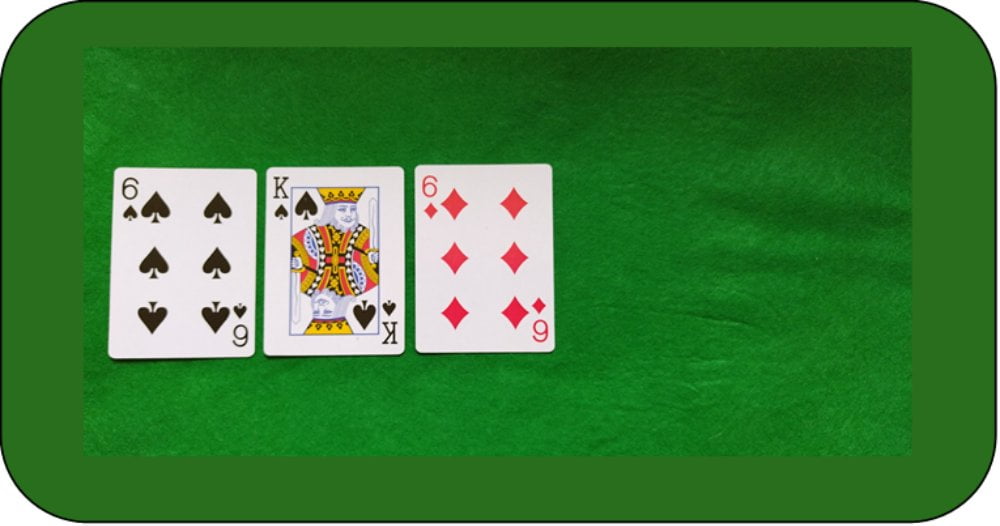
After the flop you have seen five of your seven cards, so most of the hand is already decided.
Three community cards arrive at once, which makes the flop the biggest single information event in the hand. What matters is not just whether you hit it, but what it is likely to have given everyone else.
The continuation bet. If you raised before the flop, you have already claimed to have a strong hand. Betting again on the flop follows through on that story, and it works often because your opponent missed the flop too most of the time. Use it more on dry boards, less on wet ones where opponents have real reasons to call.
This is the one piece of maths that separates players who lose slowly from players who lose fast. Get it right and most calling errors disappear.
You have a flush draw on the turn. The pot holds $100 and your opponent bets $50. Call or fold?
Step 1, count your outs. Thirteen cards of your suit exist. You hold two and two are on the board, so nine remain. Nine outs.
Step 2, convert to a percentage. With one card to come, multiply outs by two. Nine outs is roughly 18%. The exact figure is 9 divided by the 46 unseen cards, which is 19.6%.
Step 3, work out what you need. You are calling $50. If you call, the pot contains the original $100, their $50, and your $50, so $200 total. You are risking $50 to win a $200 pot, which means you need to be right 50 divided by 200, or 25% of the time.
Step 4, compare. You have 19.6% and you need 25%. Fold.
Note the denominator carefully, because this is where people go wrong. It is the pot after your call, not before it. Getting that wrong makes marginal calls look worse than they are and costs you value on close decisions.
One adjustment. Pot odds ignore money you might win later. If your opponent has a deep stack and would pay off a big river bet when your flush comes in, those implied odds can make an otherwise losing call correct. That works in reverse too: against a short stack or a cautious player who shuts down when the flush card lands, there is no extra money coming and the raw pot odds are all you have.

Casino Hold’em and live dealer tables, plus the full slots library. Check the wagering terms and any excluded games before claiming.
Position means when you act relative to the button. Acting last is a permanent information advantage, because you watch everyone else make their decision before you make yours. It is the reason the same hand is a fold in one seat and a raise in another.
This matters more than anything else on this page if you are planning to play at an online casino rather than a poker room.
Poker rooms host player against player Hold’em and take a cut of the pot. Online casinos mostly do not. What they offer instead are house-banked variants where you play against the dealer, and the differences are total:
You play other people. Bluffing works, position matters, reading opponents matters, and a better player beats a worse one over time. The house takes a rake and has no stake in who wins.
You play the dealer. There is no bluffing because the dealer cannot fold, no position, and no opponents to read. The house has a fixed mathematical edge, and the only skill is knowing when to call and when to fold.
Ultimate Texas Hold’em works similarly, with the twist that betting earlier costs you less, so raising strong hands at the first opportunity is usually correct. Neither game rewards the strategy taught above. If you take aggression and bluffing to a Casino Hold’em table you will simply lose faster, because there is nobody there to fold. Browse the options in our online table games guide or the live dealer casinos section.
Blinds never rise and you can rebuy or leave whenever you like. Chips equal money directly. You can afford to wait for good hands because sitting out costs you nothing but time.
Blinds climb on a timer and losing your chips ends your day. Waiting is not free, because rising blinds erode your stack whether you play or not. As your stack shrinks relative to the blinds you have to take risks earlier.
No. A full house beats a flush. The ranking runs royal flush, straight flush, four of a kind, full house, flush, straight, three of a kind, two pair, one pair, high card. Beginners often assume a flush is stronger because it looks impressive, but full houses are rarer.
Divide the amount you must call by the total pot after your call. If the pot is $100, your opponent bets $50 and you call $50, the pot becomes $200, so you need 25% equity. Using the pot before your call is the most common mistake and makes good calls look bad.
Count your outs, the cards that complete your hand, then multiply by two for one card to come or four for two cards. A flush draw has nine outs, so roughly 18% on the river or 36% from the flop. The exact figures are 19.6% and 35%, close enough for decisions at the table.
No. Casino Hold’em is played against the dealer rather than other players, so bluffing, position and opponent reading do not exist. Hand rankings are the same but the house holds a fixed mathematical edge, and the only decision that matters is whether to call or fold. Most online casinos offer this version rather than player against player poker.
Around 80% at a nine handed table. Playing too many hands is the defining beginner leak, and tightening up is the fastest single improvement available to most new players. Fold more from early position and widen your range as you get closer to the button.
Yes, most poker sites run play money tables where you can learn the mechanics and the pace without risking anything. Be aware that opponents behave very differently when the money is not real, so play money teaches you the rules rather than the strategy.
Hold’em rewards patience and punishes ego. Fold most of your hands, raise instead of calling when you do play, use position, and check the pot odds before every call. That short list beats the majority of casual players without any advanced theory at all.
And check what you are actually sitting down to. If it is a casino table rather than a poker room, you are playing the house rather than people, and every read and bluff in your toolkit is worth nothing there.

The 2026 Mathematical Breakdown Slot Mathematics by Mark Taylor Updated: March 12, 2026 Every single mobile slot in the app store or offshore casino lobby promises incredible ex...
Mark Taylor Slot Analysis • Updated: February 9, 2026 When you press “Spin” on a slot machine, you aren’t just engaging with graphics and sound effects; you ar...

Platform Analysis by Mark Taylor Updated: March 2, 2026 When debating between playing on mobile or desktop, the experience isn’t just about the size of the screen. It’s ab...

Mark Taylor Tournament Strategies • Updated: January 25, 2026 I remember the rush of my first online slots tournament. I wasn’t just playing against a machine; I was competing a...