[simple-author-box]

-
Casinos
Online Casinos
Casino Software:
- Crypto
-
Casino Games
Casino Games:
- Real Money Slots
- Bonuses
- Banking
- Guide
 3 December 2025
 6 minutes to read


🛡️Editorial Transparency: We independently audit all casinos. We may earn a commission if you visit them through our links. Read our Editorial Policy.
When I transfer money to an offshore casino, it doesn’t sit in a wallet waiting for me. The casino moves it the moment it arrives to manage risk and payouts.
Most players never see this internal money movement. I firmly believe it’s the reason for withdrawal delays, sudden KYC checks, and why some sites crash under big wins.
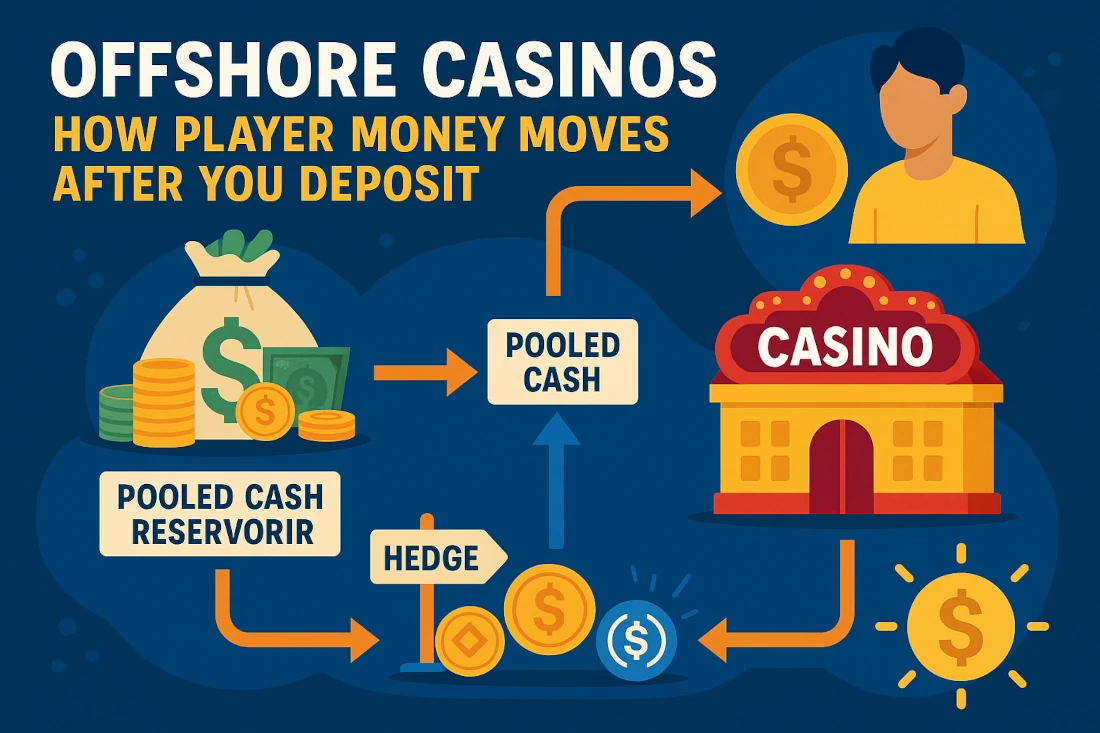
When you send money to an offshore casino, it covers wagering, bonuses, operating costs, and withdrawals. Think of it as one big bank account that keeps the casino’s daily operations running.
Offshore casinos don’t segment player funds the way a regulated US sportsbook does. They combine all player deposits. Be it BTC, USDT, or credit card payments into one internal pot.
If you’re wondering how, so? They need the largest possible buffer to handle volatility, hot streaks, and big winners.
Super Slots usually pays me within an hour. My payout comes from a shared pool and not “my” deposit. Their crypto desk uses the day’s consolidated inflows to clear withdrawals quickly.
Volatility is another thing crypto casinos have to deal with. That’s why most casinos convert a portion of incoming crypto into stablecoins or fiat. Others hedge exposure through OTC desks.
Wild Casino runs part of its reserve in USDT to avoid BTC swings. If they hold too much Bitcoin and BTC drops 6% overnight, their withdrawal buffer shrinks instantly.
Every casino fears the same thing: a cluster of big winners hitting at once. That’s why they use a pooled system. It gives them the elasticity to absorb swings.
I once cashed out $1,500 at MYBookie after a spectacular slot win on Betsoft’s The Tipsy Tourist.
They paid out multiple payouts in a single morning because several players, including me, cashed out big. That level of liquidity only works when a casino centralizes funds.
A casino’s welcome bonus, reload bonus, or free spins payouts come from this reserve. To avoid hiccups, casinos anticipate bonus abuse, promos, and expected losses in their liquidity planning.
Mark’s Insight: When I review a casino offering “massive” bonuses with slow payouts, I see it as a liquidity imbalance. Too many promos could mean “not enough reserve to pay winners quickly“.
When you request a withdrawal, the casino checks if it has enough immediate liquid assets, especially for crypto. If it’s a small pool, you’ll experience delays, excuses, or sudden KYC checks.
Smaller offshore casinos settle crypto payments within 24 to 48 hours. Is there a reason for that? Yes, they’re waiting for new deposits to refill the pot.
By now, I know that my money never travels in a straight line at an online casino. Even with crypto, the internal routing can still hop across two, three, sometimes four jurisdictions.
Before you think this is shady. In truth, it’s how offshore casinos keep their banking open. It helps them to manage risk and stay one step ahead of regulators and chargeback fraud.
Most offshore casinos licensed in Curaçao or Panama don’t have operational bank accounts in those countries. Instead, they bank in Europe or Asia because they’re more receptive towards gambling inflows.
My credit card deposit at MyBookie went through Curaçao on paper, but the merchant descriptor led back to Cyprus. That’s the norm.
The casino operates in Country A, but the merchant account is in Country B. That’s where the payment processor accepts gaming transactions.
When you deposit using Visa or an eVoucher, the processor routes the transaction through its network to the casino’s bank. This adds Country C into the chain.
A real case I saw while testing Bovada:
A player made a $250 Visa deposit. The charge showed as a digital service company in Ireland, not a gambling business in Antigua.
Bovada used that Irish processor as the “buffer” so banks couldn’t block the transaction. I don’t consider it unethical; instead, I see it as a way for offshore merchants to survive.
Many crypto casinos still move funds across multiple legal zones before they clear your deposit. Why? They use third-party liquidity desks to hedge, convert, or risk-manage your crypto.
This can involve:
When I deposit BTC at Wild Casino, it appears instantly on-chain. Yet, the internal confirmation only comes a few minutes later.
Their risk team uses a European OTC desk to pre-clear suspicious flows. It’s a security filter, not a delay tactic.
The withdrawal route rarely mirrors the deposit route. Your crypto or fiat payout may pass through a different jurisdiction depending on which liquidity pool is funding it.
At BetOnline, my LTC withdrawal might look like a direct transaction from Panama.
In reality, the liquidity pool funding is in Canada. Moreover, their blockchain desk managed the private keys outside their licensing zone. That involves three countries for one payout.
Let me put this plainly. The multi-country chain isn’t there for your convenience. Its sole purpose is to protect the casino against hostile banks, anti-gambling policies, and liquidity choke points.
As a player, the practical effect is simple:
When I see a site suddenly jump from 30-minute payouts to 48 hours, routing is usually the culprit.
Offshore casinos don’t just process payments; they work around banks that block gambling traffic. After years of testing these sites, here’s what players need to know.
During one of my BetOnline test runs, LTC deposits spiked on a Sunday. Within hours, they shifted a chunk of that LTC reserve into USDT through their OTC desk.
Why? They expected Monday withdrawals to be heavy and didn’t want LTC’s price drop to hit the payout pool. The next day, withdrawals were smooth because they rebalanced early.
Watch for shrinking max cashouts, disappearing bonuses, slower live chat replies, and sudden “maintenance” on one or two payment methods. They are early warnings that the payout pool might be in the red.
Yes. Smaller withdrawals clear faster because they don’t strain the casino’s reserve. I break large wins into two or three mid-sized cashouts.
Fast casinos keep a healthy cushion in both crypto and fiat. Slow casinos run their liquidity razor-thin and rely heavily on daily deposits.
Most of the time, yes. Crypto bypasses banks, processors, and frozen merchant accounts. If a casino’s crypto reserve is small, even Bitcoin withdrawals stall.
Play at casinos with a proven payment history. I’ll test a site with a small withdrawal first. If they can’t pay $50 or $100 without any delay, I won’t trust them with a big win.
After two decades of testing offshore casinos, the real cause is almost always internal pressure that the casino won’t admit.
The casino’s hot wallet is low, and they’re waiting for new deposits to refill it.
A processor shuts them down, or a merchant account freezes. They scramble to reroute everything behind the scenes.
When liquidity gets thin, KYC becomes a delay lever, not a security check.
If BTC or USDT experiences price swings, they’ll delay payouts.
Offshore casinos often push back smaller withdrawals so they can first clear the big ones that create reputational risk.
Offshore casinos run on liquidity. Every delay, every KYC request, and every payout time ties to the casino’s financial status. Once you understand how casinos pool deposits, you’ll see the industry through a different lens.
[simple-author-box]

Casino Policy Audit by Mark Taylor Updated: March 3, 2026 If you have ever attempted to withdraw your legitimate winnings from an online casino and suddenly hit a frustrating di...
Mark Taylor Casino Strategy • Updated: January 20, 2026 US players are often concerned about the payout speed at Bovada. Common questions flood the forums: “How long is th...

Mark TaylorChief Editor • Updated: August 7, 2026 MyBookie’s lobby runs Betsoft and Dragon Gaming. These are the 10 slots worth your money, six of them tested with our own...

Mark Taylor Chief Auditor • Updated: January 16, 2026 There is nothing more frustrating than finding a great slot, clicking “Deposit,” and seeing the dreaded “...