18+ only. Gamble responsibly. Call or text 1-800-MY-RESET.Independent reviews. We may earn a commission when you sign up, which never changes our rankings.
 4 June 2025
 7 minutes to read


Three Card Poker is the most successful proprietary casino table game of all time. Invented by Derek Webb in 1994, it was designed to bridge the gap between the speed of standard table games and the excitement of poker. It worked. Today, you cannot walk into a casino in Vegas, Macau, or London without seeing a sea of Three Card Poker tables.
For online casino players, the game offers a unique proposition: it is arguably the easiest poker variant to learn, yet it possesses enough mathematical depth to reward skilled play. Unlike Blackjack, where you must memorize a matrix of 300+ decisions, Three Card Poker has one golden rule that governs every single hand.
However, “simple” does not mean “easy to beat.” The game is filled with trap bets—specifically the Pair Plus and 6-Card Bonus—that can drain a bankroll in minutes. In this guide, I will deconstruct the game layer by layer. We will cover the combinatorics of 3-card hands, the exact EV of the Q-6-4 strategy, why betting systems like Martingale fail here, and which online casinos offer the “Full Pay” tables that give you a fighting chance.
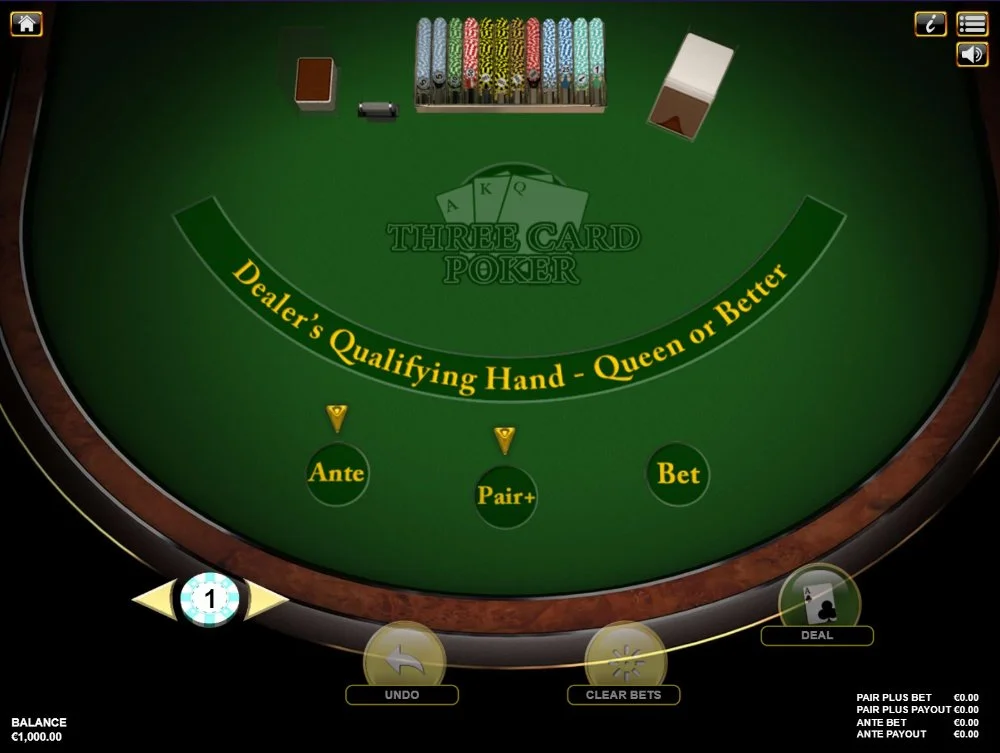
Three Card Poker is actually two games in one: the Ante-Play game (where you compete against the dealer) and the Pair Plus game (where you compete against a paytable). You can usually play one or both, though some casinos require an Ante to play the Pair Plus.
Step 1: The Ante
The game begins with the player placing a wager in the “Ante” triangle. This buys you into the hand. At this point, you can also place optional side bets.
Step 2: The Deal
The dealer gives the player three cards face down and deals themselves three cards face down. You may examine your own cards.
Step 3: The Decision (Play or Fold)
After looking at your hand, you must make a choice:
Step 4: The Showdown & Qualification
The dealer reveals their cards. This is where the game differs from standard poker. The dealer must “Qualify” with a hand of Queen-High or Better.
Experienced poker players often make a fatal mistake in Three Card Poker: they value a Flush higher than a Straight. In 5-card poker (like Texas Hold’em), a Flush is harder to hit than a Straight. In 3-card poker, the math flips.
There are $52 \choose 3$ = 22,100 total possible hand combinations in Three Card Poker. Let’s look at the frequency of each hand to understand why the rankings are different.
| Rank | Hand | Combinations | Probability | Ante Bonus (Common) |
|---|---|---|---|---|
| 1 | Straight Flush | 48 | 0.22% | 5 to 1 |
| 2 | Three of a Kind | 52 | 0.24% | 4 to 1 |
| 3 | Straight | 720 | 3.26% | 1 to 1 |
| 4 | Flush | 1,096 | 4.96% | 0 |
| 5 | Pair | 3,744 | 16.94% | 0 |
| 6 | High Card | 16,440 | 74.39% | 0 |
Key Takeaway: A Straight is statistically harder to get than a Flush (3.26% vs 4.96%), which is why it ranks higher. Do not fold a low Straight (like 2-3-4) thinking it is weak. It is a monster hand in this game.
You will hear casual players say “Play any Queen” or “Play Queen-7.” They are losing money. The mathematically perfect strategy, verified by the UNLV Center for Gaming Research, is precise:
To understand why Q-6-4 is the cutoff, we have to look at Expected Value (EV). According to extensive combinatorial analysis by The Wizard of Odds, the math breaks down like this:
It’s a razor-thin margin, but over thousands of hands, playing Q-6-3 will drain your bankroll, while playing Q-6-4 minimizes the house edge to roughly 3.37% (Ante/Play).
Strategy Cheat Sheet:
This is where casinos generate the bulk of their revenue. While the Ante/Play game has a manageable house edge of 3.37%, side bets are far more aggressive.
The Pair Plus bet pays out if you have a Pair or better, regardless of what the dealer holds. However, casinos manipulate the payouts on the Flush and Straight to change the edge. You must check the digital felt before betting.
| Outcome | Paytable A (Fair) | Paytable B (Common) | Paytable C (Greedy) |
|---|---|---|---|
| Straight Flush | 40 to 1 | 40 to 1 | 35 to 1 |
| Three of a Kind | 30 to 1 | 30 to 1 | 25 to 1 |
| Straight | 6 to 1 | 6 to 1 | 6 to 1 |
| Flush | 4 to 1 | 3 to 1 | 3 to 1 |
| Pair | 1 to 1 | 1 to 1 | 1 to 1 |
| House Edge | 2.32% | 7.28% | 7.70% |
The Verdict: Only play Pair Plus if the Flush pays 4 to 1. If it pays 3 to 1, the house edge triples. Most live dealer casinos use Paytable B, which makes Pair Plus a bad bet.
This bet looks at your 3 cards and the dealer’s 3 cards to form a 5-card poker hand. It pays massive odds—1,000 to 1 for a Royal Flush. But the variance is sickening. The House Edge typically ranges from 10% to 15%. Mathematically, this is one of the worst bets in the casino, akin to playing Keno.
Three Card Poker is a high-variance game. Because you will fold approximately 33% of your hands, you will experience long streaks of losing your Ante. Conversely, when you win, you often win 2 units (Ante + Play). This “sawtooth” pattern requires a specific bankroll strategy.
Why Martingale Fails Here
The Martingale system (doubling your bet after a loss) is suicide in Three Card Poker. Why? Because you aren’t just betting 1 unit; you are often betting 2 units to stay in the hand. If you hit a losing streak and reach the table limit, you can’t double to recover. Plus, the “Dealer Not Qualifying” rule means sometimes you win the Ante but push the Play, disrupting the doubling math.
Based on a $10 Ante bet, here is how much bankroll you need to survive a 2-hour session with a < 5% risk of going bust:
Not all online casinos offer fair paytables. We audited the top US-facing sites to see who offers the best odds and fastest payouts.

Wild Casino uses the “Standard” paytable for Pair Plus (House Edge 7.28%), which is the industry norm online. However, they stand out for their Table Limits ($1 to $500) and payout speed.

Super Slots runs on the same reliable software as Wild Casino but offers a distinct $6,000 Bonus. Their mobile platform is optimized for portrait mode, making it easy to play Q-6-4 strategy one-handed.
Three Card Poker is a game of discipline. The Q-6-4 strategy is your shield against the house edge. If you stick to it, you can enjoy hours of play with a relatively low expected loss. If you start chasing “Pair Plus” flushes or playing J-10-9 because you “have a feeling,” you will lose. Treat the game with mathematical respect, verify the paytables, and may your next hand be a Straight Flush.
The mathematically optimal strategy is to Play (bet) on any hand of Queen-6-4 or better, and Fold any hand weaker than that. This minimizes the house edge to approximately 3.37%.
Yes. In Three Card Poker, a Straight is statistically rarer than a Flush (3.26% vs 4.96%), so the Straight ranks higher and pays more.
It depends on the paytable. If the casino pays 4:1 for a Flush, the house edge is a reasonable 2.32%. If they pay 3:1 (which is common online), the edge jumps to 7.28%, making it a bad bet.
No. The dealer needs a Queen High or better to qualify. If they don’t qualify, your Ante pays 1:1 and your Play bet is returned (push). This happens about 30% of the time.
Playing blind (betting Play on every hand without looking) increases the house edge to over 7.6%. It is mathematically disastrous and not recommended.

Mark Taylor Tournament Strategies • Updated: January 25, 2026 I remember the rush of my first online slots tournament. I wasn’t just playing against a machine; I was competing a...
Mark Taylor Casino & Sports Strategy • Updated: January 20, 2026 Every gambler eventually asks the same question: “Is it easier to beat the dealer or the bookie?”...
The 2026 Mathematical Breakdown Slot Mathematics by Mark Taylor Updated: March 12, 2026 Every single mobile slot in the app store or offshore casino lobby promises incredible ex...
Mark Taylor Jackpot Strategy • Updated: February 10, 2026 Traditional progressive jackpots are frustrating. You can spin for months and never see the needle move. Hot Drop Jackp...