-
Casinos
Online Casinos
Casino Software:
- Crypto
-
Casino Games
Casino Games:
- Real Money Slots
- Bonuses
- Banking
- Guide

 21 November 2025
 7 minutes to read



Some days, you log into your favorite casino and immediately fire up the latest Pragmatic Play or Hacksaw Gaming drop. Lately, it feels like they launch a new high-volatility grid slot every single day with an exciting theme, and you are there purely for the entertainment, the crisp HTML5 graphics, the new cascading features, and that quick dopamine hit.
🛡️Editorial Transparency: We independently audit all casinos. We may earn a commission if you visit them through our links. Read our Editorial Policy.
But if you are anything like me, you have also endured those grueling sessions where you burn through a $300 bankroll on a “cool new slot,” lean back in your chair, look at your zeroed-out balance, and think: “I should have put that money into a proper, life-changing progressive instead.”
That is the ultimate, persistent tension for smart players attempting to manage a limited bankroll. Do you aggressively grind out smoother, longer sessions on mathematically safe high-RTP games? Or do you aim the bankroll squarely at highly volatile progressive jackpots that can actually move the needle in real life?
In this technical guide, let us cut entirely through the marketing myths and look at this from a real, mathematical player’s point of view—not the casino’s, and not the game provider’s.
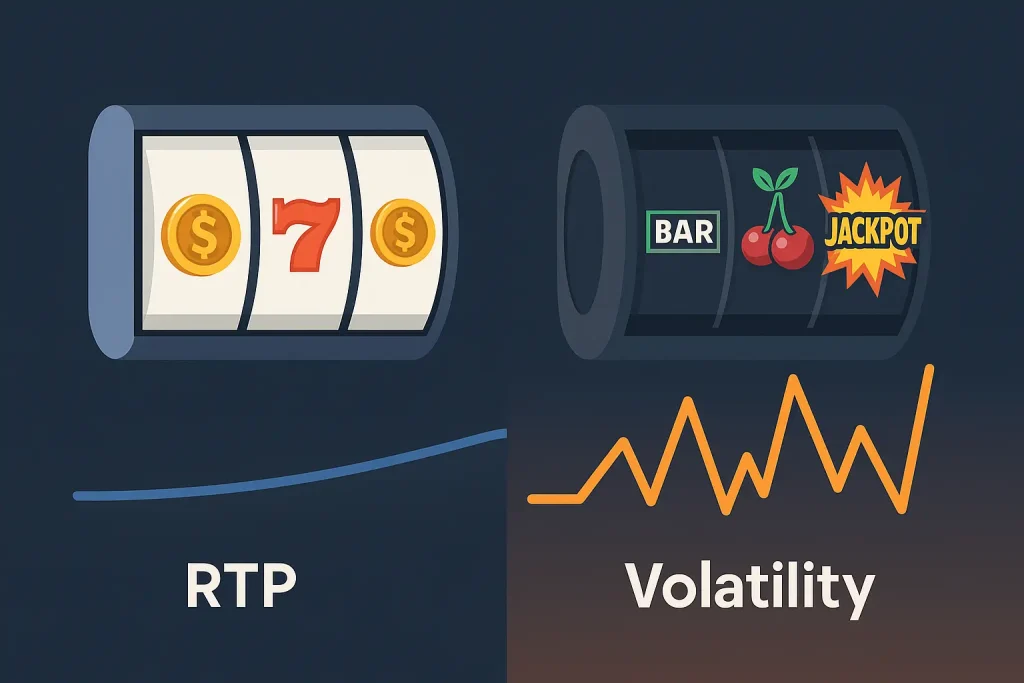
You will constantly hear forum “experts” and affiliate marketers claim: “Only play high-RTP slots, they mathematically have better odds.” It sounds incredibly logical on the surface, but when you actually understand how slot algorithms and standard deviation work, you realize that statement is only half-true—and absolutely not in the way casual players think.
RTP (Return to Player) is a long-term casino macroeconomic metric, not a short-term prediction of your specific Tuesday night session. As strictly defined by global regulators, if a real money slot displays a 97% RTP, it simply means:
Your actual, realized session RTP is almost never exactly “97%”. It is whatever the immediate variance of the spins gives you over the next hour. You might spike a massive 500x multiplier in the first 10 spins and end your session at a 4,000% RTP. Alternatively, you might hit a brutal cold-streak for 200 spins, trigger zero bonuses, and end at a devastating 12% RTP.
Here is exactly where recreational players get incredibly nervous: almost all progressive jackpot slots openly display a significantly lower base RTP (often hovering dangerously around 88% to 92%).
On paper, they look like terrible, “worse” investments. But the real value is not sitting in the base percentage; it is heavily concentrated in the extreme volatility profile and the mathematically inflating jackpot pool.
Or in simple, strategic terms: the true value is built into the volatility, not the base RTP.
Progressives work by shaving a small fractional percentage (usually 1% to 5%) off every single spin globally and feeding it directly into a shared, centralized pot. That specific pot keeps rising exponentially until the RNG randomly selects a winner. The bigger it gets, the more “loaded” every single spin becomes.
At a certain mathematical threshold, if the jackpot climbs high enough without hitting, the effective RTP of the machine can actually blow past 100%; meaning your Expected Value (EV) per spin is technically profitable. This happens because the potential prize pool is now massively disproportionate to your $1.00 bet size.
If you want to play progressives highly effectively, you must utilize casinos that openly display live, real-time jackpot values. This allows you to actively target mathematically inflated jackpots instead of spinning blindly.
High-RTP slots definitely feel safer. On paper, they should provide you with significantly smoother returns over a very long play session. In reality? Your session still comes down entirely to whether the RNG hits a feature, or whether it doesn’t.
A pristine 97.5% RTP slot can absolutely cold-streak you straight into a zero balance. Conversely, a terrible 90% RTP progressive can absolutely smack you with a life-changing bonus round on spin number three. The fundamental difference isn’t “good RTP vs bad RTP,” it is how the specific game is mathematically built to distribute its wins.
Most high-RTP slots (especially low-volatility ones like Starburst or Blood Suckers) are algorithmically designed to deliver:
That mathematical structure is absolutely perfect if your primary goal is low-risk entertainment or meticulously clearing a brutal 40x wagering requirement on a casino bonus. But let’s be brutally honest about the reality of the math: those safe, frequent little hits do not change anything for your life. They simply slow down the inevitable downward loss curve. You are paying for time on the machine, not a chance at wealth.
Progressives throw that safe, low-variance model entirely away. They pay out significantly less often during the base game, but when they finally connect, they swing incredibly hard. We are talking about wins that actually matter.
This is exactly where the math ends and personal risk tolerance begins. Forget the stated RTP for a second. Forget the flashy affiliate marketing. You must ask yourself one critical question before you deposit: What does “winning” actually mean to me tonight?
That’s exactly where you read the headlines about a life-changing $3.7M win. You are never promised the big one. But mathematically, you have a non-zero shot. A high-RTP slot might be much smoother on your heart rate, but it rarely gives you access to that kind of financial ceiling.
Not every progressive is worth chasing at all times. The modern industry has evolved to include highly specific mechanic types that demand operational timing.
Some networks feature a defined “Must-Drop” or “Daily Drop” range. This means the algorithm is hardcoded to force the jackpot to hit before a certain maximum financial threshold (e.g., $250,000) or before a specific time limit expires (e.g., Midnight). Others, like the legendary Mega Moolah network, are purely uncapped and keep growing indefinitely until someone nails them.
The higher the central pot climbs relative to its usual historical hit range, the more mathematically “loaded” each individual spin becomes. You are no longer just hoping for blind luck. You are stepping into a specific time window where the risk-to-reward curve tilts significantly more in your favor than usual.
If the pot looks average and recently hit, you are just playing a standard, punishingly volatile game with a terrible base RTP. If the pot is visibly inflated way above its historical normal drop zone, you are actively entering the game at maximum Expected Value upside.
You are still gambling against the house edge, but you are no longer spinning randomly. You are timing your shots precisely when the mathematical reward profile is at its absolute peak.
It depends entirely on how you personally define “better odds”. If you define it exactly like a casino compliance analyst—by looking at long-term, macroscopic returns across hundreds of thousands of simulated spins—then High-RTP slots technically offer a much better long-term survival curve.
But that clinical definition does not match how real human players gamble. You are playing tonight, with a specific budget. If “better odds” means a calmer, longer ride, stick to the high-RTP games. If “better odds” means a real, non-zero chance of a life-shifting hit, allocate your bankroll to the progressives. One engine offers consistency. The other engine offers absolute possibility. Only you can decide which mathematical profile is worth risking your next deposit on.
Because a fraction of every spin (usually 1% to 5%) must be syphoned off to fund the growing jackpot pool, the base-game RTP is mathematically lowered (often around 88% to 92%) to ensure the casino still maintains its standard long-term house edge.
Unlike traditional uncapped progressives, a Must-Drop jackpot is hardcoded by the software developer to trigger before a specific mathematical limit is reached (e.g., $10,000) or before a specific time limit expires (e.g., Midnight every day).
It depends entirely on the specific game’s rules. Many older, classic slots mathematically require a maximum coin bet to even qualify for the top prize. However, modern mega-progressives (like Mega Moolah) allow players to trigger the jackpot wheel randomly on any bet size.
Generally, no. The vast majority of online casinos specifically restrict progressive slots in their promotional Terms and Conditions. If you manage to hit a massive jackpot while using active bonus funds, the casino will likely confiscate the winnings.